S corporation taxation is one of the topics by small business owners who want to reduce taxes legally and understand how profits are treated. Many people hear that an S corporation can save money, but they are not fully clear on how it works.
This guide explains how s corps is taxed, what the s-corp tax rate really means, how filing works, what deductions are available, and how business owners calculate savings.
What Is S Corporation Taxation?
S corporation taxation is a special tax structure allowed by the IRS. An S corporation is not taxed like a regular corporation. Instead of paying corporate income tax, profits pass through to the owners.
That means:
- The business itself does not pay federal income tax
- Profits go directly to shareholders
- Owners report income on personal tax returns
- Taxes are paid at individual income tax rates
This structure for s-corp tax rate avoids double taxation, which is common in C corporations.
How Are S Corps Taxed?
When people search how the s corps are taxed, they usually want a direct answer. The simple answer is this:
- The company files an informational return
- Profits or losses pass to shareholders
- Owners pay taxes on their share of profits
- Income is taxed at personal rates
This system is known as pass-through taxation, and it is the core idea behind s corporation taxation.
Unlike a traditional corporation, the IRS does not apply a fixed corporate rate to profits. Instead, each owner pays based on their personal bracket.
What Is the Tax Rate for S Corporation?
Many business owners search what is the tax rate for s corporation expecting one number. But there is no single s-corp tax rate.
Here is why:
| Income Type | Who Pays | Tax Rate Applied |
| Business profit | Shareholder | Personal income tax rate |
| Owner salary | Shareholder | Payroll taxes + income tax |
| Distributions | Shareholder | Income tax only |
So the s-corp tax rate depends on:
- The owner’s income level
- Filing status
- State taxes
- How much is taken as salary vs distribution
This flexible structure is a major feature of s corporation taxation.
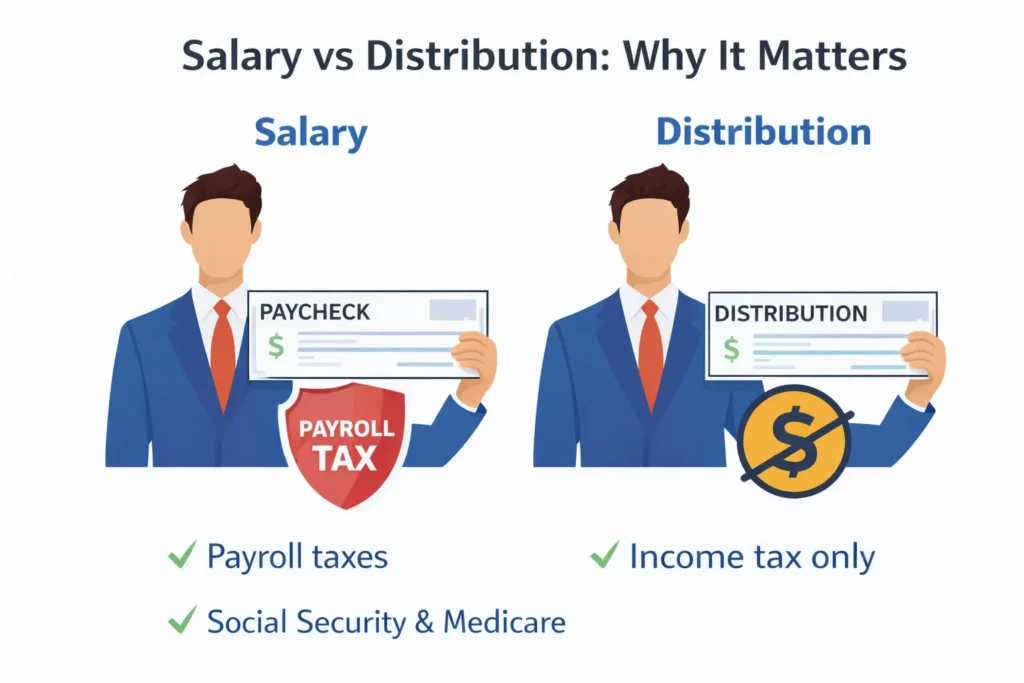
Salary vs Distribution: Why It Matters
One of the biggest benefits of s corp is how compensation is handled.
Owners must take a reasonable salary. That salary:
- Is subject to payroll taxes
- Includes Social Security and Medicare
But distributions:
- Are not subject to self-employment tax
- Are still subject to income tax
This difference creates s corp tax savings when structured correctly.
Example Breakdown
If a business earns $120,000:
- $60,000 taken as salary
- $60,000 taken as distribution
Payroll tax applies only to the salary portion. This reduces total employment taxes.
This is one reason s corporation taxation is popular among service businesses and consultants.
Benefits of S Corp Structure
The benefits of s corp status go beyond just payroll tax savings.
Main Advantages
- Avoids double taxation
- Potential payroll tax savings
- Limited liability protection
- Pass-through losses
- Credibility with clients
Because of these factors, s corporation taxation often becomes the preferred choice once a business grows beyond sole proprietorship level.
S Corporation Tax Filing Process
Every year, an S corporation must complete specific forms.
Required Forms
- Form 1120-S
- Schedule K-1 for each shareholder
- Payroll tax filings
- State tax forms if required
s corporation tax filing does not mean the company pays income tax. It reports profit allocation to owners.
Each shareholder receives a Schedule K-1 showing their share of income. That income is reported on personal returns.
Understanding the filing process and s-corp tax rate is essential to managing a corporation taxation properly.
S Corporation Tax Deductions
One major strength of s corporation taxation is the wide range of deductions allowed.
Common Deductions
- Office rent
- Business insurance
- Employee salaries
- Health insurance premiums
- Equipment purchases
- Vehicle expenses
- Marketing costs
- Professional fees
These s corporation tax deductions reduce taxable profit before it passes through to shareholders.
Lower profit means lower personal tax liability.
How to Estimate Taxes with an S Corp Income Tax Calculator
Many business owners use an s corp income tax calculator to estimate potential savings.
A typical calculation compares:
- Sole proprietor self-employment tax
- S corp payroll tax + income tax
Basic Comparison Table
| Structure | Self-Employment Tax | Corporate Tax | Income Tax |
| Sole Proprietor | Yes | No | Yes |
| S Corporation | On salary only | No | Yes |
These calculators help visualize the impact of s corporation taxation before making the election.
State Taxes and S Corporations
Federal rules are clear, but state laws vary.
Some states:
- Recognize S corp status fully
- Charge minimum franchise tax
- Impose additional filing fees
Because of this, s corporation taxation may differ slightly depending on location.
Always review state-specific regulations before assuming savings.
When Does S Corp Make Financial Sense?
Not every business benefits from s corporation taxation.
Generally, it makes sense when:
- Annual profit exceeds $40,000 to $50,000
- Owner takes consistent income
- Business has predictable cash flow
- Payroll setup costs are manageable
Below that level, administrative costs may offset tax savings.
Common Misunderstandings About S-corp tax rate
Many people assume:
- There is a fixed s-corp tax rate
- S corps avoid all taxes
- Distributions are tax free
None of these are accurate.
The s-corp tax rate is not a flat number. It depends on individual income levels.
s corporation taxation still requires income tax payment. It simply avoids double taxation at corporate level.
Long-Term S Corp Tax Savings
Over time, structured properly, s corp tax savings can add up significantly.
Savings typically come from:
- Reduced self-employment tax
- Optimized salary distribution balance
- Maximized deductions
- Retirement contributions
Strategic planning enhances the benefits of s corporation taxation year after year.
Conclusion:
Understanding s-corp tax rate gives business owners clarity and confidence. It explains how profits flow, how taxes are applied, and where savings occur.
There is no single what is the tax rate for s corporation answer because everything depends on personal tax brackets and compensation structure.
But with proper planning, accurate filing, and structured salary management, the system can create measurable financial advantages.
Frequently Asked Questions
How are s corps taxed compared to LLCs?
S corporations use pass-through taxation where profits are taxed at personal rates, but payroll taxes apply only to salary. LLCs taxed as sole proprietors pay self-employment tax on all profit, which often increases total tax liability.
What is the tax rate for s corporation profits?
There is no fixed s-corp tax rate. Income passes to shareholders and is taxed at their individual federal and state income tax brackets based on total earnings and filing status.
Does an S corp pay federal income tax?
An S corporation does not pay federal income tax at the corporate level. Instead, it files an informational return and shareholders report income on their personal tax returns.
Are distributions taxed in s corporation taxation?
Yes, distributions are taxed as income, but they are not subject to self-employment tax. This difference creates potential payroll tax savings compared to sole proprietorship income.
What forms are required for s corporation tax filing?
S corporations must file Form 1120-S annually and provide Schedule K-1 forms to shareholders. Payroll tax filings and state tax forms may also be required.
Can s corporation tax deductions reduce personal taxes?
Yes, business deductions reduce the company’s net profit before income passes to shareholders, lowering the total taxable income reported on personal returns.
When should a business switch to s corporation taxation?
A business typically considers S corp status when profits consistently exceed around $40,000 to $50,000 annually and payroll tax savings outweigh administrative costs.
Is there a minimum income required for s corp tax savings?
There is no legal minimum, but meaningful tax savings usually occur when profits are high enough to justify payroll setup and accounting expenses.
Does state law affect s corporation taxation?
Yes, some states impose franchise taxes or minimum annual fees, which can impact overall savings. State regulations should always be reviewed before electing S corp status.
How does an s corp income tax calculator help?
An s corp income tax calculator estimates salary, distributions, payroll tax, and income tax to compare structures and determine potential annual tax savings before making the election.
One thought on “How S Corporations Are Taxed: A Clear Guide for Business Owners”
Comments are closed.